Thursday, 29 July 2010

Top foods that boost energy levels

Your hectic schedule may cause you to experience a shortfall of energy. How can you up your energy quotient to cope with your workload, and pursue your interests?


There are several strategies to help you boost your energy and metabolism, including exercising, getting enough sleep and stress control. Here we'll focus on foods since what you eat essentially determines your energy levels.
Here's a quick list of food choices that will rev up your metabolism and help you perform at your peak throughout the day.
More metabolism with pepper
You can boost your metabolism for that extra burst of energy by eating spicy chili peppers. Capsaicin, the active ingredient in peppers, can increase your metabolism by about 23 percent if consumed in the right amount. About a tablespoonful of chopped red or green chilies will do the trick. What's more, this can also help you lose some weight.
Remember however, individuals having hemorrhoids, piles or irritable bowel syndrome (IBS), should not opt for this.
Fibre-rich items like whole-grain breads, brown rice, oats, green vegetables and high-fibre cereals like muesli, unlike processed food, are able to generate a continual stream of energy as they are broken down in the body. These food items, defined as 'low glycemic', don't get used up immediately in the body, rather are metabolized slowly and as a result, release energy in smaller chunks, keeping blood sugar levels stable.

Additionally, research shows that getting around 25 gms of fibre a day can also help you burn more fat, up to 30 percent. Chick peas, black beans, and sprouted lentils are great sources of fibre.

Two-thirds of women face sexual problems

Almost two-thirds of women suffer from sexual dysfunction, according to a study.
Two-thirds of women face sexual problems
Dysfunction rose with age in all categories except orgasm, with more than half of women aged from 18 to 30 reporting orgasm problems, significantly higher than women aged 31 to 54.
Researchers asked 587 women aged from 18 to 95, who attended a urology clinic in New Jersey, about six key areas of female sexual dysfunction (FSD)-lack of desire, arousal issues, lack of lubrication, problems achieving orgasm, lack of satisfaction and pain during intercourse.
"We found that 63 percent of the women suffered from FSD and that there were significant links between FSD and age, menopausal status and use of selective antidepressants" said co-author Dr Debra Fromer, head of the Center for Bladder, Prostate and Pelvic Floor Health at Hackensack University Medical Center, New Jersey.
They attended a typical American metropolitan urology practice caring for conditions such as urinary incontinence, urinary tract infections, pelvic floor problems and kidney stones.

And the findings revealed that the most sexually active age groups were 31-45 year-olds (87pct), followed by 18-30 year-olds (85pct) and then 46-54 year-olds (74pct).
It then fell sharply in 55-70 year-olds (45pct) and in women who were over 70 (15pct).
The top overall problem was lack of desire (47pct), followed by orgasm problems (45pct), arousal issues (40pct), lack of satisfaction (39pct), lack of lubrication (37pct) and pain (36pct).
Five of the six categories increased as the women got older- desire from 36 to 96pct, arousal from 27 to 54pct, lubrication from 26 to 45pct, satisfaction from 28 to 88pct and pain from 10 to 56pct.
The only category that bucked the trend was orgasm, with problems higher in the 18-30 age group (54pct) than in the 31-45 (43pct) and 46-54 (48pct) age groups.
It then rose to 66pct at 55-70 and 87pct when women were over 70.
"FSD can have a major effect on women's quality of life. Self-esteem, sense of wholeness and relationships can be seriously and adversely affected, exacting a heavy emotional toll," said Fromer.
"Researchers have found significant associations between major categories of sexual dysfunction, reduced physical and emotional satisfaction and general well-being.
"That is why it is so important to ensure that problems are identified and tackled wherever possible. For example a number of hormone and other drug treatments have been shown to benefit women with FSD," added Fromer.
Known risk factors for FSD include age, a history of sexual abuse or sexually transmitted infections, depression, lower socioeconomic status, lifestyle, overall physical health and sexual experience.
The study is published in the August issue of BJUI.

Travel magazine names Bangkok world's top city

Bangkok city officials say they are humbled and inspired after receiving Travel + Leisure magazine's "Top City" award, despite recent street riots that sent tourists packing.
Travel magazine names Bangkok world's top city
Bangkok Gov. Sukhumbhand Paribatra poses with World's Best city award during a press conference in Bangkok, Thailand
Bangkok Gov. Sukhumbhand Paribatra told a news conference that the award offers a morale boost to the battered capital and called on political protesters to behave themselves. The recent political upheaval prompted dozens of international travel advisories and emptied hotels.
"What we have in our hands is very precious," said Sukhumbhand. "We must prevent troubles and any more losses from happening in our beloved city. We should not damage it any further."

Travel magazine names Bangkok world's top city
A shot of the Marble temple in Bangkok, Thailand
A grenade explosion Sunday in a central Bangkok shopping area killed one person and wounded 10. Authorities have declined to speculate if it was politically related.
The No. 1 ranking in the magazine's top 10 cities list appears in the August edition of Travel + Leisure, which was based on a poll of readers who cast votes from December to March to rate their favorite cities, islands, hotels, airlines and other categories. Nearly 16,000 readers participated. The polling stopped a few days before civil disorder erupted in Bangkok that lasted 10 weeks and ended May 19 with nearly 90 dead and 1,400 hurt.

Travel magazine names Bangkok world's top city
A Buddha statue is polished by a Thai worker
During the chaos, several top hotels and upscale department stores closed because they were surrounded by thousands of anti-government protesters. Dozens of buildings were damaged or burned as the protests were broken up in a military crackdown.
Nationwide hotel occupancy in May -- the end of tourism's high season -- was 32 percent, down 10 percent from the same period last year, said Prakit Chinamornpong, president of Thai Hotels Association.

Travel magazine names Bangkok world's top city
New York City came in at number 10 on the list
The Bangkok governor visited New York last week to pick up the award from the magazine's publishers and said he met with Mayor Michael Bloomberg and asked for advice about New York's post 9-11 recovery.
"'Bad things happened, but we must move forward. We can't stop. We must keep up the morale.' That's what Mayor Bloomberg told me," he said.

Travel magazine names Bangkok world's top city
Florence, Italy grabbed the third spot on the list
New York City ranked 10th among favorite cities in the poll. Second was the northern Thai city of Chiang Mai, followed by Florence, Italy.

Travel magazine names Bangkok world's top city
The Mexican town of San Miguel de Allend snagged the fifth spot
Coming in at number 4 was San Miguel de Allende, Mexico.
Travel magazine names Bangkok world's top city
AT number 5, the appeal of Rome is alive and thriving
The Italian capital of Rome rounded out the top 5 favourite cities in the world.
Bangkok also was the top city in 2008. 


Want to buy a flying car? Wait till 2011


Terrafugia, Inc, developer of the Transition Roadable Aircraft, or "Flying Car", released, on Monday, specifications and computer graphics of the exciting  new Transition. Deliveries of the Transition are scheduled to begin in late 2011.
The improvements to the design are based on data acquired during drive and flight testing of the Proof of Concept, successfully completed in 2009, and extensive computer-aided design and optimisation.
Some features in the next generation design include:
  • Automotive-style crash safety features including an energy absorbing crush structure in the nose of the vehicle and a rigid safety cage to protect the occupants.
  • A customised, intuitive touch-screen interface in the cockpit.
  • An improved wing with an optimised airfoil and a folding mechanism that operates smoothly and safely from inside the cockpit.
  • A pusher propeller with an open empennage that makes efficient use of the 100 hp Rotax 912S mid-mounted engine in flight and is locked in place when driving.
  • Rear-wheel drive with a continuously variable transmission (CVT) and tuned independent suspension for responsive road handling.
  • Terrafugia (terra-FOO-gee-ah), based in Woburn, MA, comprises a team of award-winning engineers who have been advancing the state of personal aircraft since 2006.
    Founded by five pilots who are graduates of Massachusetts Institute of Technology and supported by a world-class network of advisors and private investors, Terrafugia's mission is the innovative expansion of personal mobility.  "Terrafugia" is Latin for "escape from land."
    The Transition combines the unique convenience of being able to fold its wings with the ability to drive on any surface road in a modern personal airplane platform.
    Stowing the wings for road use and deploying them for flight at the airport is activated from inside the cockpit. This unique functionality addresses head-on the issues faced by today's Private and Sport Pilots.

The fastest Internet in the world!


The fastest broadband city in the world is Masan in South Korea, according to an analysis.
The data, from network giant Akamai reveals the average global net speed is only 1.7 Mbps (megabits per second) although some countries have made strides towards faster services.
And Masan in South Korea stands at the top with Internet speed of 12 Mbps.
At the second spot is Hong Kong with 9 Mbps, followed by Japan with 7.8 Mbps.
Rounding up the top 5 are Romania and Latvia with 6.3 Mbps speed each.
In the speed league table, the UK is ranked 27th out of 201 countries, with an average speed of 3.8 Mbps.
This is below the 5.2 Mbps average speed calculated by regulator Ofcom in its annual broadband report.
"Other countries have got faster," the BBC quoted David Belson, head of market intelligence at Akamai, as saying.
Even in South Korea, which tops the speed league table and is often perceived as enjoying super-fast broadband as the norm, the average speed is a relatively slow 12 Mbps, with the average maximum hitting 33 Mbps.
"100 Mbps is available in South Korea but it is often at prices that are not affordable by the general public. It can cost several hundred dollars a month," said Belson.
Asia dominates the list of fastest wired cities with more than half of the top 100 cities in Japan. Only 12 US cities make the list.All the top twenty cites were in either Japan or South Korea, with the exception of Umea, in Sweden, which was ranked 18th.
Other European cities in the top 100 included Baden-Baden in Germany, Wageningen in the Netherlands and Timisoara in Romania.
Average net speed by region is as follows:
  • 1. South Korea 12 Mbps
  • 2. Hong Kong 9 Mbps
  • 3. Japan 7.8 Mbps
  • 4. Romania 6.3 Mbps
  • 5. Latvia 6.3 Mbps
  • 6. Sweden 6.1 Mbps
  • 7. The Netherlands 5.9 Mbps
  • 8. Czech Republic 5.4 Mbps
  • 9. Denmark 5.3 Mbps
  • 10. Switzerland 5.2 Mbps

British PM's mantra: Money and more money


Even though British Prime Minister David Cameron on his first visit to India as the head of state followed the usual protocol - meeting President Pratibha Patil and Prime Minister Manmohan Singh, his agenda was more to do with trade relations than politics.
His huge delegation comprising six Cabinet ministers, including Chancellor of the Exchequer George Osborne, too, talked money, and well, more money... There were 13 chiefs of British universities, also.
If things move as per plan, then a bilateral meeting between the two prime ministers will be held, where Cameron is expected to promote Britain's education and nuclear energy sectors, besides cornering a few lucrative infrastructure deals.
In the afternoon, when Cameron came to Taj Palace Hotel in Chanakyapuri, the bandobast (security arrangements) were so tight in and around the hotel that media person were frisked thrice before being allowed to enter the hotel.
Click on NEXT to read more...

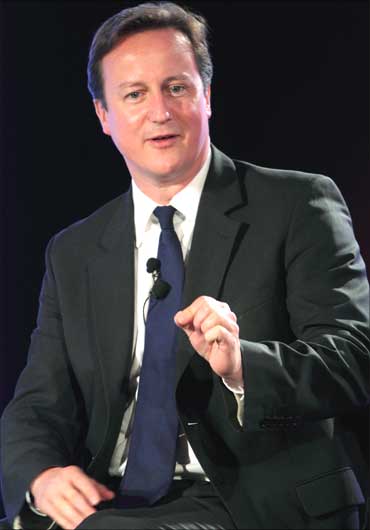
Image: Britain's Prime Minister David Cameron speaks during a business meeting in New Delhi.
Photographs: Stringer/Reuters
     Next
     Next
Sheela Bhatt in New Delhi

Even though British Prime Minister David Cameron on his first visit to India as the head of state followed the usual protocol - meeting President Pratibha Patil and Prime Minister Manmohan Singh, his agenda was more to do with trade relations than politics.
His huge delegation comprising six Cabinet ministers, including Chancellor of the Exchequer George Osborne, too, talked money, and well, more money... There were 13 chiefs of British universities, also.
If things move as per plan, then a bilateral meeting between the two prime ministers will be held, where Cameron is expected to promote Britain's education and nuclear energy sectors, besides cornering a few lucrative infrastructure deals.
In the afternoon, when Cameron came to Taj Palace Hotel in Chanakyapuri, the bandobast (security arrangements) were so tight in and around the hotel that media person were frisked thrice before being allowed to enter the hotel.
Click on NEXT to read more...

Image: Britain's Prime Minister David Cameron speaks during a business meeting in New Delhi.
Photographs: Stringer/Reuters
     Next
Prev     Next
However, not too many corporate honchos were present in the hall.
Naina Lal Kidwai group general manager and country head of HSBC, Rajen Bharti Mittal, chief of Federation of Indian Chambers of Commerce and Industry and Ajit Gulabchand, chairman and managing director of Hindustan Construction Company and couple of other big daddies of India Inc saved the day.
Forty-three year old Cameron entered the hall almost running. His opened his short speech, which was laced with confidence, with a reminder that he was giving special importance to India.
He mentioned how Queen Elizabeth II's speech, that outlined his government's agenda, had specifically mentioned the good relationship that Britain enjoys with India.
In a well-rehearsed televised event he tried to inject some natural air. His youthfulness also touched the audience.


While it seemed that Cameron is not too well-trained for public diplomacy, he is indeed media savvy, highly energetic and suave.
When confronted with questions on his young age - whether it will prove to be advantageous or the contrary - Cameron dexterously replied by saying positive things both about his age and the coalition government in Britain.
Cameron said the biggest threat to European countries is the issue of public finance. Among the G20 nations Britain, he said, has the highest fiscal deficit.
While Osborne and Cameron explained how they have taken step to cut public spending to control budget deficit, Deputy Chairman of Planning Commission Montek Singh Ahluwalia, Commerce Minister Anand Sharma and HRD Minister Kapil Sibal spoke about the great business potential that exists between the two countries.
In response to Sibal's statement that how millions of Indian students are searching for proper education and how the country is looking for ways to provide schools and training institutes at the cost of crores of rupees, Cameron urged young Indians to opt for British universities for better education.


Britain, he said, has plenty to offer.
Listing down the advantages that Britain offers, Cameron said the country has some of the best-run universities, English language, strong financial sector, civil nuclear power sector and time zone which is between Asia and the US. He said, Britain's 'welcoming economy is open.'
While Cameron could convince the Indian audience that he was indeed bullish on building a strong relationship with India, a well-known BBC anchor pointed out that while the prime minster was willing to have a robust relationship with India, his countrymen shared no similar enthusiasm.
Graham Cole, managing director of Agusta Westland said, "People who know India well, like my company, understands business opportunities and issues of Indian society. It will take time but surely interest in India is growing within Britain." Cole said he recently sold helicopters to Ratan Tata.
.


Cameron, who drew flak for Britain's new immigration laws, tried hard to clarify that tight laws and better trade ties are in no way clashing.
A senior British expert of petroleum industry said, "Cameron wants strong business relation with India because it's a well-thought out decision of the British politicians. I think Britain has judged that it's easier to trade with India than China.
Two, they think both will be important countries in future, and, three, this visit of Cameron is to take a hard look at various Indian sectors to decide where Britain can invest. They are still searching for the best business options in India."
Cameron and his men surely meant business.


China's shift, Korean peninsula and Middle East pose new risks: Anshu Jain, Deutsche Bank


When Wall Street biggies bit the dust two years ago, some European banks stood like a rock. Among them was Deutsche Bank, which had the image of a smart, conservative German bank that sensed the subprime fiasco well before others. Today, when Europe as a region looks less secure, that image may have changed a little. In an interview with ET, Anshu Jain, widely perceived as one of the most powerful bankers in Europe, shares his views on the risks ahead for world markets, the Euro, and Deutsche’s businesses, among other things. 

Mr Jain, who took questions from ET while visiting India as part of UK’s Chancellor of the Exchequer George Osborne’s delegation, said the chances of a double dip depression were slim. A month back, the Indian-born Jain hit the headlines when he took over as Deutsche Bank’s head of corporate and investment bank, sparking speculation that he may succeed CEO Josef Ackermann. This week Mr Jain overhauled Deutsche’s investment bank by putting in place a 15-member management team. Some thought it was Mr Jain’s move to strengthen his grip on the investment banking division of Germany’s biggest lender. Excerpts: 

What will your new role be? 

In one sense, my new role is very much an evolution because I have already been co-head of our Corporate and Investment Bank (CIB) for nearly six years. But the opportunity to integrate further our three CIB businesses — corporate finance, markets and transaction banking — while preserving what rightfully distinguishes them is very exciting. Together, we will produce even more ideas and value for clients and create incremental return for Deutsche Bank’s shareholders. 

There is a perception that Deutsche is becoming more multi-cultural and more multinational. 

Deutsche Bank has long been a highly international company, but always from a starting point of strength in our German home market. In fact, our roots date to the 1870s when the bank started out as a financier to help German companies grow by reaching international markets. Today, you can see that heritage reflected in the unique local markets franchise that we possess with operations in more than 75 countries — from Frankfurt and London to Almaty and Surabaya. As a multi-cultural institution, our employees represent 92 nationalities. 
Going forward, where do you see the opportunities for investment banking?

The micro-economic outlook is positive, with cash-rich corporate clients looking to invest, a healthy mergers and acquisitions pipeline and continued long-term growth in emerging markets. But clients also face a number of challenges such as the macro-economic environment, large government deficits and uncertainty over the extent of future regulation. The key, as ever, will be staying close to our clients.

European markets have been choppy and spreads have widened. What’s the outlook for Indian issuers?

Indian issuers, like others, may see some concern from global investors as risk aversion leads to widening of credit spreads, but there is still demand for Indian paper. Indian banks are liquid with strong balance-sheets and double-digit core capital ratios. In July alone, Deutsche Bank helped the State Bank of India and ICICI Bank raise $1.5 billion from the international bond markets. 

What will be the impact of the Dodd-Frank Wall Street Reform and Consumer Protection Act?

It is still hard to tell. The positive impact could be a more robust financial system from increased capital requirements, transparency, consumer protection and rules for facing future crises. However, the potential negative impact could be reduced lending, higher funding and operational costs, weaker economic growth, and regulatory arbitrage due to differences between global approaches. We believe there is a need for new financial regulation, but it should take into account potential risks to the global economic recovery.

Several European banks have failed in the stress test...

Many major banking systems in Europe, including France, the UK and Ireland, have been recapitalised and have cleaned up their balance sheets, leaving just a few pockets of concern, such as Spanish cajas. This exercise was a positive step towards greater European coordination to stabilise the sovereign and banking systems.

What’s your outlook for the euro and the euro region?

Our forecasters maintain a constructive forecast for the euro, which they see trading up from current levels of about $1.30 to a level of $1.35 by the fourth quarter or early 2011. Sentiment has turned less bearish towards the currency, thanks to easing concerns over the euro-area system. For the euro region, we forecast GDP growth of 1% in 2010, with significant upside potential. We see stronger performance in the core, with Germany growing 2.0%, softening the blow of austerity in countries such as Spain, down 0.7%, and Greece, down 4.2%.

We have always maintained that there is the political will and grass-roots support to prevent a sovereign credit event. The effort underway in Europe to address structural fiscal imbalances is unprecedented and although it will dampen activity in the very near term, it will position Europe well in one or two years’ time.

There are renewed fears of a double dip recession. Do you see that as a possibility?

While we expect a soft patch in growth on the back of further deleveraging and fiscal tightening, we believe that the downside risk of a double dip remains small and see global growth at 4.4% in 2010 and 4% in 2011. The global economy still appears to be expanding at a reasonably firm pace thanks to robust growth in emerging markets, which is more than offsetting a modest downward adjustment in the outlook for industrial countries.

Deutsche was possibly the first bank to sense the enormity of the subprime crisis. What do you fear could be the next big risk for world markets? Something you feel that banks and markets need to watch out for?

We are warning our clients about a number of risks. Sovereign debt levels in developed markets have risen to unprecedented peace time levels which will result in an equally unprecedented fiscal contraction over the coming years. Some weaker European banks may find it harder to fund themselves in the market, making them more reliant on the European Central Bank. China’s transition towards a consumption driven economy carries some risks, as do the perennial geopolitical tensions around the Korean peninsula and the Middle East. 

Moves like capping of bankers’ salaries and discouraging big banks which are too big to fail have captured popular imagination, but many bankers feel this could make financial services industry less efficient.

A lot has already changed within the banking system: Stronger risk management procedures, better liquidity management provisions, greater transparency in the securitisation market, and tighter compensation structures. At Deutsche Bank, for example, we have reduced by over 90% the capital once allocated to dedicated proprietary trading.

With regard to the size of banks, we believe there are better factors to focus on if the aim is to bring about greater stability. After all, many of the most stable banks throughout the past two years have been the biggest. On compensation, regulators and banks should ensure that employees are incentivised in ways that generate long-term value for customers and shareholders.

How significant is Deutsche Bank’s Indian franchise and what are your growth plans in India?

India is one of our fastest growing markets and a global priority for Deutsche Bank. The Indian franchise represents around 10% of the global workforce with over 7,500 employees. Deutsche Bank in India contributes nearly a quarter of our Asia profitability and has grown at an impressive 25% compound annual growth rate over the last five years. Even in the midst of the financial crisis of 2008, we expanded our capital in India, making Deutsche Bank one of the largest investors in India.

Do you see the Indian client needs as being different from how Deutsche Bank services its global clients?

Indian clients are increasingly becoming global in their outlook and, as they continue to outpace their counterparts around the world, their appetite for funding and capital is increasing. Hence clients look to banks which offer products and solutions across the entire spectrum: debt, equity, advisory, foreign exchange and transaction banking in an integrated manner, under one roof. Deutsche Bank, with its global strengths and leadership in most of these products, is well positioned to meet Indian clients’ needs locally as well as across geographies.

Globally, Deutsche Bank has been recognised for its success in investment banking in 2010. What has really helped business during the year?

The story of Deutsche Bank in investment banking is one of resilience. We delivered a powerful, if unexpected, turnaround performance in the past year, but on a substantially changed business model that consumed far fewer resources. We reduced assets and risk and the capital dedicated to proprietary trading.

We are already seeing the benefits of recalibrating our business model to focus even more on our strengths of low-risk client trades, intellectual capital and deep local market penetration. We have gained market share across sales and trading, corporate finance and transaction banking, winning a number of key awards. 


India does not plan to ban BlackBerry services


India's internal security chief said on Thursday that there were no plans to ban Research In Motion's (RIM.TO) (RIMM.O) popular BlackBerry services in the world's fastest growing mobile phone market.
Earlier Internal Security Chief U.K. Bansal told reporters that his department had raised national security concerns with RIM over the data services, but expected a solution to be found soon. [IN:nSGE66S09D] (Reporting by Bappa Majumdar; writing by Paul de Bendern; editing by Malini Menon).

Commonwealth Games faces threat from Jat Community

Claiming to be victims of government apathy since decades, scores of members from Jat community gathered here on Wednesday to voice their demand for reservation in government jobs.
Seeking affirmative action by the government, the demonstrators issued a warning to the central government that if their demands were not met, they would disrupt the Commonwealth Games to be staged in New Delhi during October.
In the highly charged agitation organised under the banner of Akhil Bharatiya Jat Aarakshana Samiti (ABJASS), the demonstrators staged a fiery protest march and raised anti-Government slogans in a unique show of solidarity.
"We will observe the Jat Chetavani Diwas (Jat Warning Day) in Delhi on September 13, in which there would be a shutdown of the region. If our talks with the central government fail, we would completely block the national capital region from October 2," said Yashpal Malik, National ABJASS President.
Earlier, on June 14, the Jats had stopped the water supply to New Delhi from the Ganges canal in Uttar Pradesh as a mark of protest against the government not heeding to their demand for reservation.
"Till now, we used to accept whatever the government used to promise us. But now, we will only accept those promises, which they make public through the media. The government would have to release through the press what it intends to do for the Jats. Only then we would accept the government's contention," added Malik. (ANI)

Raina becomes ninth Indian to score century on debut

Suresh Raina
Suresh Raina became the ninth India [ Images ]n batsman to score a hundred on a debut for India.
Raina, who replaced Yuvraj Singh [ Images ] in the team, drove a length ball outside the off stump straight past the bowler to complete the ton.
He is 59th in the overall list of centurions on debut.
Raina, who is an integral part of India's One-day team has played 98 ODIs, with three centuries in the kitty.
Raina was involved in crucial partnership with Sachin Tendulkar [ Images ] to bail India out of a precarious situation in the second Test against Sri Lanka [ Images ].
Three others (Lala Amarnath, Abbas Ali Baig & Gundappa Viswanath) have done so in the second innings of the debut Test - taking the tally of debut centurions for India to 12.

Here-under is the list of highest scores for India in the debut innings:
Batsman Runs VS Venue Season
SC Ganguly 131 Eng Lord's 1996
S Amarnath 124 NZ Auckland 1975-76
DH Shodhan 110 Pak Kolkata [ Images ] 1952-53
M Azharuddin 110 Eng Kolkata 1984-85
Hanumant Singh 105 Eng Delhi [ Images ] 1963-64
V Sehwag 105 SA Bloemfontein 2001-02
PK Amre 103 SA Durban 1992-93
AG Kripal Singh 100* NZ Hyderabad 1955-56
SK Raina 100* SL Colombo SSC 2010

Wednesday, 28 July 2010

The 10-year-old 'king' who sells scrap for a living

Rahul MirHe is amazingly responsible for his age. At 10, Rahul Mir not only goes to school but also earns and contributes to his family.
He collects and sells scrap in and around West Bengal's [ Images ] South 24 Parganas district. "It adds to my family's resources and in turn helps me continue with my studies.
"I want to be a policeman when I grow up. Therefore, I need to study hard."
He gets up around 5 every morning, goes to the dumpyard close to his home, does his 'chores' for about a couple of hours and after submitting the day's collection to his father, who is also in the same 'job', leaves for school.
"Collecting scrap may otherwise seem a dumb job. But you know what, I have learnt to keep myself entertained. As I pick up each piece of scrap, I try and imagine the 'story' it carries," he tells rediff.com.
He takes out two chunks of metal from the heap, puts one on his head, holding the other and shouts, "Ami raja Rahul akhon, juddho ghoshona korchhi (I am king Rahul, the war has begun.)'
And then in the same breath, fishes out a part of another metal with a question, "Do you know what is this? This is a part of a bicycle. It must have gone so old that the owner had to sell it."
"How can someone sell a bicycle," he wonders. "Why not?," you ask and he responds, "A bicycle comprises more than half of my dreams. I think of possessing one every minute, dream of riding it every second."
However, a family of four that earns only Rs 5,000 a month can't even afford visualising one, let alone buying it.
Hence, all that the 10-year-old can do at the moment is scan the city's biggest dumpyards collecting scrap, wishing all the while that some miracle some day would convert it into a two-wheeled wonder.

A rally for Women's Bill in New Delhi

The Alliance for 33%, a group of more than 300 women's groups, including political leaders and artists, have announced a rally in New Delhi [ Images ] on Thursday, demanding an immediate passage of the Women's Reservation Bill.
The Alliance has invited all political parties in Parliament to come together to lend their support to the cause of women's right and equality in India [ Images ].
"The UPA lacks political will and social commitment necessary for getting the bill passed. The parties opposing the bill are preventing women from coming into mainstream politics," said Annie Raja, national general secretary of National Federation of Indian Women( a women's wing of Communist Party of India), in a statement.
The march between Jantar-Mantar and Parliament will be addressed by political leaders-Alka Lamba, Brinda Karat [ Images], Jayanti Natarajan and Kanimozhi and artists like Javed Akhtar [ Images ], Sharmila Tagore [ Images ] and Mallika Sarabhai.
According to Beulah Shekhar of YWCA, "It is now or never! To achieve the Millennium Development Goal No.3 which aims at promoting gender equality and empowering women, India has to pass the bill now."

Mobiles have 18 times more bacteria than toilet handle

The average mobile phone carries 18 times more potentially harmful germs than a flush handle in a men's toilet, tests have revealed. One of the phones in the test had such high levels of bacteria that it could have given its owner a serious stomach upset.
The findings from a sample of dozens of phones by Which magazine suggest 14.7 million of the 63 million mobiles in use in Britain today could be potential health hazards, reports the Daily Mail. Hygiene expert Jim Francis, who carried out the tests, said: "The levels of potentially harmful bacteria on one mobile were off the scale. That phone needs sterilising."
The most unhygienic phone also had 39 times the safe level of enterobacteria, a group of bacteria that live in the lower intestines of humans and animals and include bugs such as salmonella. It boasted 170 times the acceptable level of faecal coliforms, which are associated with human waste.
Other bacteria including food poisoning bugs e.coli and staphylococcus aureus were found on the phones but at safe levels. Which researcher Ceri Stanaway said: "The bugs can end up on your hands which is a breeding ground and be passed back to your phone. They can be transferred back and forth and eventually you could catch something nasty.
"What this shows is how easy it is to come into contact with bacteria. People see toilet flushes as being something dirty to touch but they have fewer bacteria than phones. "People need to be mindful of that by observing good hygiene themselves and among others who they pass the phone to when looking at photos, for example."
Which magazine had previously found that some computer keyboards carry more harmful bacteria than a lavatory seat.

Before marriage select The World's Most Fabulous, Most Affordable Wedding Gowns

The World's Most Fabulous, Most Affordable Wedding Gowns

When Rebecca Selvenis, who works in Human Resources in Google's New York office, set out looking for a dress for her upcoming wedding, she had three goals in mind--to find something beautiful, romantic and, most importantly, inexpensive. It's a sentiment echoed by brides-to-be across the country. Sure, they want a knockout dress for their wedding, but these days many don't consider it an expense worth maxing out a credit card or becoming indebted to a family member. This comes as a big cultural shift from just a few years ago, when women often spent more than they could afford on their dream dresses.
The World's Most Fabulous, Most Affordable Wedding Gowns
Call it the H&M effect. Today's brides are expecting high-design wedding dresses for a fraction of the cost of a designer dress.
According the Knot's 2009 Real Weddings Survey, the average price paid for a wedding dress in 2009 was $1,134, a drop from the 2007 high, when women spent $1,317 on average for a wedding dress. Perhaps more telling, according to a study released by David's Bridal this year--50% of brides to be consider it a priority to spend less than $800 on their dress, and 54% of those surveyed said getting a designer dress wasn't important to them.
Compare this to the priorities of brides in 2007, when 47% responded that they wanted to purchase two dresses for their wedding (one for the ceremony and one for the party) and 60% wanted a customized designer wedding dress. Women are scaling back on their spending--and on their expectations.
Selvenis ultimately walked away from her wedding dress search with a white satin column Amsale gown she bought at a sample sale for $500, half her dress budget. She couldn't be happier in not breaking the bank, and put the money saved toward the down payment on an apartment. "I want a beautiful wedding day through the warmth and love of the occasion, not the extravagance," she says.
Retailers have been quick to respond to this new bride, who is more of a recessionista than a free-spending bridezilla. J.Crew led the mass-market charge, launching three bridal dresses online in 2004 made of silk, taffeta and tulle. The line has now expanded to about 45 dresses per season, ranging in price from the very affordable $325 to the more aspirational $3,500.
It has been such a successful venture for J.Crew that the line has expanded to include veils, shoes and accessories, and the retailer opened its first stand-alone wedding boutique in June on New York's Madison Ave. Following J.Crew's lead, Ann Taylor has found success with a range of relaxed chiffon wedding gowns priced around $500.
And David's Bridal recently announced it is partnering with wedding doyenne Vera Wang on a range of dresses that will hit stores next spring, priced between $500 and $1,500. Considering Wang's ready-to-wear bridal gowns start at just under $4,000 and go up to $13,000--this is following a 40% to 50% price cut the company made last year to reflect the downturn--and that her custom gowns can cost up to $100,000, this new collection is bordering on bargain-basement.
It's not just the megabrands that are thinking about affordability. Project Runway winner and Houston-based designer Chloe Dao launched a collection of wedding gowns and short wedding dresses this April--most for under $1,500--following the success of her inexpensive QVC line, Simply Chloe Dao.
"In 30 or 40 years the biggest memory for the bride will not be the food or the venue; it will be her wedding dress," she says. While she says that brides still consider finding a perfect dress to be a crucial element in their wedding planning, she says they are "shopping smarter," demanding unique and modern dresses that are affordably priced.
No retailer has tested just how frugal brides are today quite like The Limited, which launched two wedding dresses last month--each for a mere $298. The Limited CEO Linda Heasley doesn't believe her company's gowns are "aggressively priced." Rather, "They are priced right in line with the store's philosophy of offering great fashion at a great price," she explains. "And customers are really responding to that right now."
Heasley traveled the country talking to The Limited's customers, many of whom were already shopping the store for their engagement party and honeymoon outfits. Based on their feedback, she realized women would be eager to buy a very inexpensive wedding dress as long as it had a chic and timeless feel. The launch includes a silk chiffon strapless wedding gown and a belted strapless silk cotton gown.
Similarly, White House Black Market has found runaway success with its $498 ivory satin wedding dress with a fitted bodice and asymmetrical hem. The initial run, which launched in four cities and via special order in March, was immediately back-ordered in sizes 00 through 16. Donna Noce, brand president of White House Black Market, says, "We are allowing our customer to look amazing and feel unique, while not having to break the bank on a wedding dress, so she can spend that money on other things that are important to her."
The dress was launched with little fanfare and spread by word of mouth, thanks to wedding blogs like Project Wedding and The Bridal Wish List. Noce says White House Black Market's call centers have been inundated with inquiries from brides to moms and aunts of brides asking about the dress. To expand on the success, the line will launch two more bridal gowns in September.
Women aren't just turning to retail chains offering inexpensive dresses--they are also reworking vintage dresses, combing through sample sales and searching bridal boutiques where they can get great deals. New Orleans-based Sofia Curdumi, a consultant who is getting married next year, found a local tailor to rework her mother's wedding dress for a fraction of the cost of a new gown. "I knew that I didn't want to spend $2,500 on something I would never wear again. I wanted something that was both sophisticated and practical." Being thrifty runs in the family: She says her mother's wedding gown cost $125 in 1980.
Jennifer Berger, who works in a New York City art gallery and is getting married this fall, started her dress search at wedding behemoth Kleinfeld, where, she says, "I was disturbed that I couldn't find a dress for under $5,000." Ultimately she found a boutique in Brooklyn, recommended by a family member, where she could get a discount. "There is so much money involved in a wedding," she says. "At the end of the day I didn't feel like I had to go crazy with the cost of my dress." She picked out an ivory mermaid-style gown with crocheted lace and a 1940s feel. "It's just as beautiful as anything I could have gotten elsewhere, and I got a great deal to boot," she says.
Mass-market retailers have clearly latched on to something hot. After all, every bride wants to look radiant on her wedding day. If she can do so at a fraction of the cost, why not? And retailers are far from finished feeding the surging demand: Expect wedding dress lines from Anthropologie and Disney next year.

What This Chinese Hacker Could Teach Apple

What This Chinese Hacker Could Teach Apple

If tough love is the best way to fix the world's software, then Wu Shi may be one of the information security industry's unsung heroes.
What This Chinese Hacker Could Teach Apple
Since 2007 the 35-year-old Shanghai-based researcher has found and reported more than 100 critical flaws in Web browsers like Internet Explorer, Safari and Chrome that could be used to hijack users' computers when they browse to an infected Web page. In the last year alone he's sold more than 50 of those flaws to vulnerability bounty projects like Zero Day Initiative and iDefense, organizations at Hewlett-Packard and VeriSign, respectively, that pay researchers for bug information and use the data in security products before passing it on to affected software vendors.
Those numbers represent more flaws reported to Zero Day Initiative and iDefense in a single year--and certainly more vulnerabilities in Web browsers--than practically any other researcher in the world. And more than half those flaws have been in Apple's Safari browser.
In one security update last month, for instance, Apple released 64 new patches for its iPhone operating system. Only six of those security problems had been identified by Apple's internal researchers. Twelve had been identified by researchers at Google. Fifteen had been identified by Wu.
"Perhaps Apple should hire Wu Shi to help them, since apparently he can find more than twice the bugs their whole security team can find," fellow security researcher Charlie Miller told Forbes at the time.
In instant messenger and e-mail conversations, Wu explains how he uses a method known as "fuzzing" to harvest those bugs. Fuzzing a browser involves entering a stream of tweaked files into the program to see which cause it to crash, and then analyzing those crash instances to see which would allow a hacker to insert code that would give him or her control of the browser.
Wu uses his own unique algorithm to generate those test files, and throws them at his own Apache Tomcat server, allowing him to test more samples at a higher frequency than the average researcher. Instead of merely switching single variables in a file, he says his method changes the entire sample, making as many changes as possible that still allow a browser to recognize the file as HTML. "My fuzzing framework focuses on the software's structure, not the details," Wu said.
Wu doesn't perform deep analysis on the bugs he finds, says Aaron Portnoy, a research manager at ZDI who has examined his findings. But Portnoy says the Chinese researcher's full-file fuzzing catches bugs that other approaches can't. "These files have complex hierarchies of related items. Instead of changing one of those items, he can change how the relationship tree works," says Portnoy. "A lot of people fuzz data. He fuzzes relationships."
Wu says he came up with his bug-finding breakthrough after a series of career disappointments. As China's stock market bubble swelled in 2006, his job at a small IT firm began to feel like a sinking ship. "I fell deeper and deeper into despair," Wu said. "On my salary, I couldn't even feed myself."
He left the IT firm and launched a startup based on peer-to-peer file sharing technology. But when a big customer refused to pay for a major project it had commissioned, his partner took another job and the company collapsed.
Wu began assembling a security consultancy and experimenting with fuzzing ideas he'd first had as a student at Fudan University years before. He found several Microsoft security flaws and reported them to the company directly before a friend told him about "vulnerability buying" programs like ZDI. "From that time on, I became a full-time bug hunter," he says.
The hunt has been fruitful. ZDI has paid Wu at least $5,000 for each of the 50 bugs it's bought from him, and iDefense has on occasion paid more than $10,000 for a single flaw. Wu won't say just how much those rewards have added up to, though some simple math shows they go well beyond a quarter of a million dollars--a tidy sum in China. ZDI has also awarded Wu "platinum status," a title that comes with a $20,000 bonus and a free trip to the Black Hat security conference in Las Vegas.
The idea of hundreds of critical security bugs in the hands of a mainland Chinese researcher might worry some in the wake of several widespread cyber espionage networks recently linked to China. The very public hacking of Google, Juniper, Intel, Yahoo and several other companies by cyberspies seemingly based in the country, for instance, used a flaw in Internet Explorer that could have been found with techniques similar to Wu's.
But Wu says that he has sold bugs only to those that "don't do evil" and report the bugs directly to software vendors. For some Internet Explorer bugs, he says he's had offers of 10 times ZDI's bounty from black-market buyers. But moral questions aside, Wu wants none of the risks that come with criminal associations.
Even so, the sheer numbers of vulnerabilities that Wu has found may be troubling, particularly in Apple's software. Wu says that he focuses on Apple's flaws because it's clear that the company hasn't. (Apple did not immediately respond to a request for comment.)
While Microsoft has been busy hardening its software against a decade of attacks--Wu cites threats like the Code Red worm that spread to hundreds of thousands of computers in 2001 and defaced websites with the phrase "Hacked By Chinese!"--Apple has enjoyed complacent years of being ignored by cybercriminals.
But Wu says that lull can't last. The rise of targeted attacks, for instance, has meant that Apple's smaller market share can no longer shield the company from dealing with security issues. "The iPhone and Mac OS are much easier to attack than Windows 7," he says. "I think in the future there will be a lot of attacks on Apple's software."
In other words, Apple's turn to be "hacked by Chinese" may come soon enough. And not all of them will be as charitable as Wu Shi.
See Also: The Mac Hacker Strikes AgainResearcher Will Expose 20 Hackable Apple FlawsHow To Hijack 'Every iPhone In The World'

Followers

Search Engine Submission - AddMe